#navbar-iframe { height: 0px; visibility: hidden; display: none; } LASOTA Sixth Grade Language Arts: reading #navbar-iframe { height: 0px; visibility: hidden; display: none; }
Showing posts with label reading. Show all posts

Wednesday, April 21, 2010

Literature Circles

We will begin a novel unit shortly, but first we are learning our roles for literature circles. What are literature circles?

}Groups that meet regularly to discuss assigned readings.
}Open, natural conversations happen.
}Roles are assigned to each student.
}Each student must bring required materials to the discussion (or they do not participate…).

Some students may have participated in circles like these before, but we are requiring students to be prepared very specifically for the in-depth, meaningful conversations we want them to have. There are 5 roles that will be assigned, plus two roles that everybody will take on:

We have begun learning the roles of summarizer and word wizard. To summarize we are using the summarization strategies "Somebody Wanted But So," and "Fortunately, Unfortunately." We practiced these strategies using Pixar short films and some of the short stories we have read this year.

Knick Knack (Pixar Short)

Somebody (Character)
◦The snowman in the globe.
Wanted (Main Goal)
◦To party with the bikini knick-knack girl
But (Conflict)
◦All of his attempts to exit the snow globe failed
So (Result/Solution)
◦He remained stuck in the snow globe which had fallen into a fish tank during his rush to escape.

Fortunately
◦The snowman in the snow globe had a lot of tools to try to break out and join the bikini girl at the party.
Unfortunately
◦All his attempts failed, and he was trapped in his snow globe, which had fallen into a fish tank, and was still unable to get to the ladies.

This skill will be practiced on the role sheets as we begin the novel in the coming days.

Tuesday, April 13, 2010

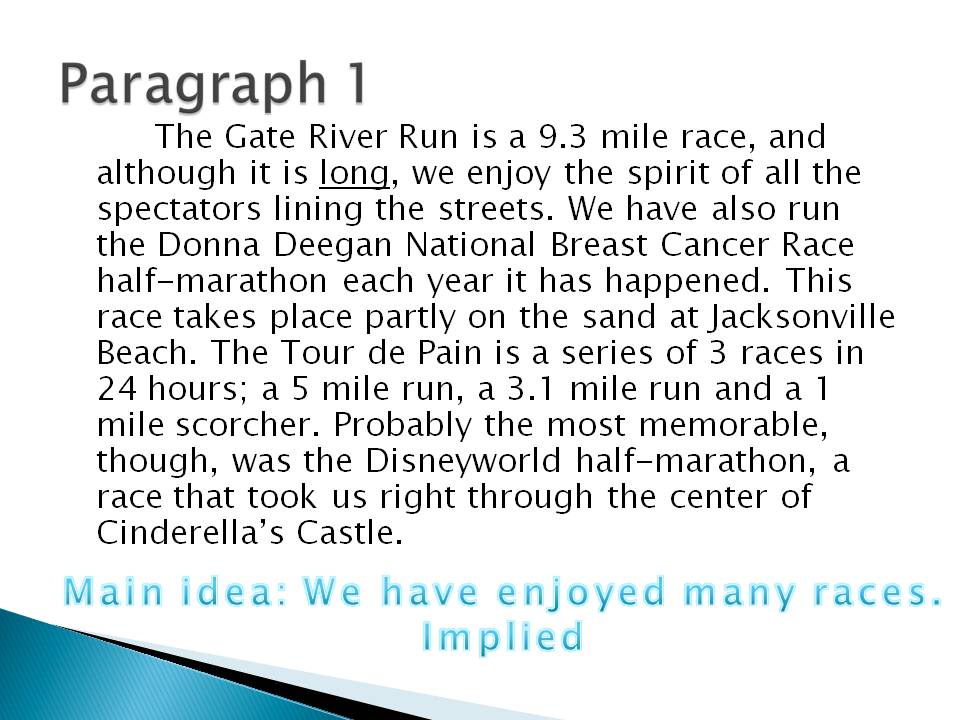
Main Idea: State or Implied?


In class we are working some more on main idea of paragraphs, this time by writing some of our own. It is so much harder to write an implied main idea, we're finding. This critical skill will help students to determine the important information when reading for any subject!

Friday, March 12, 2010

Topic, Main Idea, and Theme

Over the next few weeks it is our goal that every student will be able to state with confidence:


  • Topic: The subject of the story.
  • Main Idea: A summary of the events of the story. It may be stated or implied.
  • Theme: A central meaning or purpose to the story, usually a generalization about a life situation.
Our study will span the definitions of these three important concepts, and include application to paragraphs, familiar stories, the short stories we've already shared in class, and even popular fables and fairy tales. We will then apply this learning to the independent reading that students are choosing (and logging) for this month. One tool to bolster development of main idea is the "Three Word Main Idea Map," similar to the one located on the back of this month's log.

In class we will read a bit of historical fiction, a short story set in the time of the historic eruption of Mt. Vesuvius.

With a deeper understanding of these concepts we can increase comprehension and the complexity of the discussions of the texts we read.

Thursday, February 25, 2010

QAR - Question/Answer Relationship

Question Answer Relationships (QAR) has successfully improved the reading comprehension of students in a variety of geographical and educational settings, including suburban, rural, general education, and bilingual education. QAR provides students and teachers with a common vocabulary to discuss the comprehension strategy of questioning. QAR helps students to better answer comprehension questions in their reading.
In QAR students learn the difference between answers that are found “In the text” and “On my own”. As evident above research demonstrates the importance of an awareness of question types, QAR teaches students to use the question answer relationship to improve reading comprehension.
In class we will be discussing, demonstrating, creating and answering all 4 kinds of questions, and then applying this strategy to FCAT-style questions and the sample FCAT materials. This Active Reading Strategy will provide our students with another tool to maximize comprehension.

Friday, February 19, 2010

SQ3R

In class we have been focusing on non-fiction texts, their text features, and strategies for reading these informational texts with active reading strategies. We have begun to work with a strategy called SQ3R.


SQ3R:
Survey – look at pictures, captions, title, first and last sentence.
Question – turn each text feature into a question and write them on your paper, leaving space for notes.
Read – The text!
Respond – Answer each question in your notes.
Review – Your notes to study!


We worked with non-fiction textbooks and current events articles. Students were shown a strategy to set up 2-column notes and SQ3R for studying content area information, where folding back the page makes for a handy self-quiz tool.

Most importantly, SQ3R reminds us to be active readers, survey and predict, ask and answer questions, and review the content when we read.

In class next week students will be completing an SQ3R using a current events article.

Monday, December 7, 2009

Making Connections

We are working on active reading strategies. One important role of the reader is the connector. We discussed the three kinds of connections that readers make: text-to-self, text-to-text, and text-to-world.


Why make connections?

It helps us:
•understand how characters feel and the motivation behind their actions.
• have a clearer picture in our head as we read thus making
us more engaged.
• keep us from becoming bored while reading
• set a purpose for reading and keeps us focused
• see how other readers connected to the reading
• become actively involved
• remember what we have read and ask questions about the text
•have a stronger understanding of the writer’s message
We are practicing these connections with selections from the literature book along with the self-selected novels that students are logging and reading.

Thursday, October 29, 2009

Look for the new monthly reading log

One of the best ways to become a stronger reader? Read! We'll be using this log to track and learn more about our students reading habits. 120 minutes of reading per week will be a breeze - less than 15 minutes per day. Find books and genres your children enjoy. Logs will be checked in class at the end of the month.

On the back of the log is a reflection activity that reinforces skills and concepts taught in class.